

Behind the Shades
On wonder, trust, and the Father who sees what we cannot.

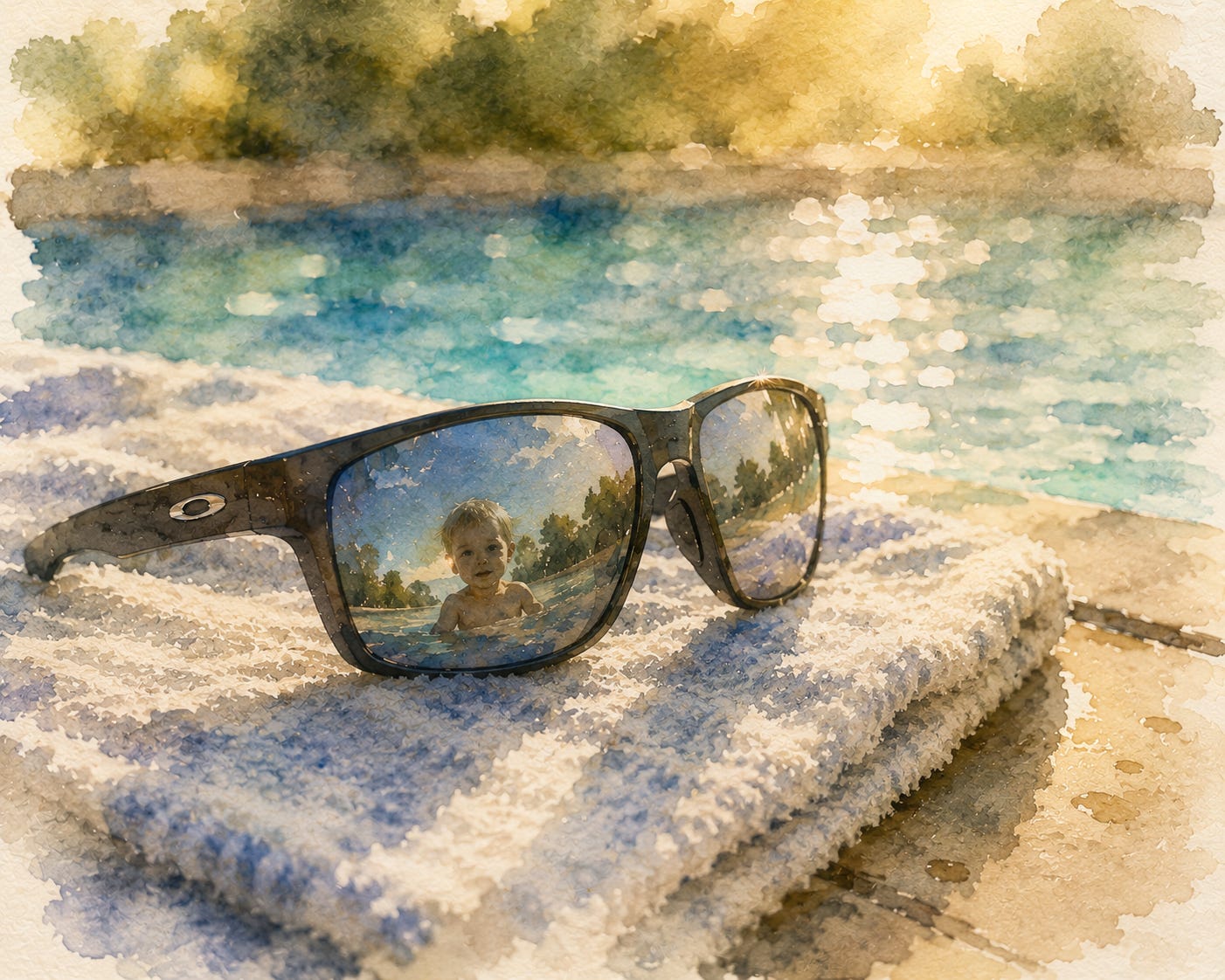
Gray was in his dad’s arms, splashing around in the pool.
We were doing what families do on hot Texas afternoons—laughing, practicing kicks, celebrating every little bit of courage as he grows more comfortable in the water.
My husband was wearing the same mirrored sunglasses he wears for teaching and coaching. They’ve become part of his uniform. His soccer players know them well. Before games, they’ll laugh and ask him to stand still so they can use the lenses as a mirror to fix a ponytail, straighten a headband, or check their eye black.
It’s so ordinary that I hardly notice them anymore.
Gray did.
At some point, he looked up at his dad and froze.
His face lit up.
There, in those mirrored lenses, he caught his reflection.
He leaned in.
Pulled back.
Looked again.
He was captivated.
Not because he had found a mirror, but because he knew exactly who was behind the shades.
We laughed together, watching his wonder unfold.
I’ve accepted that I never really know where my husband is looking when he’s wearing those sunglasses. The mirrored lenses hide his eyes. Is he watching Gray kick? Looking toward the deep end? Keeping an eye on another family nearby? I usually can’t tell.
Gray couldn’t tell either.
But it didn’t seem to matter.
He wasn’t trying to see through the lenses.
He wasn’t asking what his dad could see.
He was simply content to be held by the one wearing them.
I’ve been thinking about that ever since.
I wonder if faith is often more like that than we realize.
We spend so much of our lives wanting God’s perspective. We want to know what tomorrow holds, why certain doors close, why others open, why prayers seem delayed, or why seasons linger longer than we’d hoped.
We want to see what He sees.
Yet Isaiah reminds us:
“For my thoughts are not your thoughts, neither are your ways my ways,” declares the Lord. “For as the heavens are higher than the earth, so are my ways higher than your ways and my thoughts than your thoughts.” (Isaiah 55:8–9)
Those verses aren’t an invitation to frustration.
They’re an invitation to trust.
The Father sees what His children cannot.
Gray had no idea what his dad could see beyond those mirrored lenses.
He couldn’t know where his eyes were fixed.
But he knew who was behind them.
That was enough.
Maybe that’s what childlike faith looks like.
Not understanding everything God sees.
Not demanding His perspective before we’ll trust His heart.
Simply resting in the One who holds us.
There’s another layer I can’t shake.
Gray wasn’t looking for himself.
He was looking toward his father.
And somehow, in drawing near, he caught a glimpse of himself.
Scripture tells us we were created in the image of God. Sin has distorted that image, but it has never erased it. Through Christ, God is restoring what was broken. Paul writes that “we all, with unveiled face, beholding the glory of the Lord, are being transformed into the same image” (2 Corinthians 3:18).
The order matters.
We behold.
Then we are transformed.
Maybe we’ve spent too much time trying to discover ourselves by looking inward.
Maybe identity was never meant to be found there.
Perhaps it has always been discovered in relationship with our Father.
The closer we draw to Him, the more His likeness begins to emerge in us—not because He becomes more like us, but because, by His grace, we are becoming more like Him.
Gray wasn’t searching for a reflection that afternoon.
He was simply close to his father.
Maybe that’s where transformation begins too.
Not by seeing everything the Father sees.
But by trusting the One behind the shades.
Beautiful comments and well said. I responded in your note.